
Broadcast Infrastructure-assisted WPT Coverage Extension for Battery-free Environmental Monitoring IoT Systems
Copyright © 2026 Korean Institute of Broadcast and Media Engineers. All rights reserved.
“This is an Open-Access article distributed under the terms of the Creative Commons BY-NC-ND (http://creativecommons.org/licenses/by-nc-nd/3.0) which permits unrestricted non-commercial use, distribution, and reproduction in any medium, provided the original work is properly cited and not altered.”
Abstract
The deployment of massive IoT environmental monitoring sensor networks is essential to address the increasing frequency of natural disasters caused by climate change. However, supplying power to sensor nodes in remote mountainous areas remains a critical challenge. This letter investigates a broadcast infrastructure-based Wireless Power Transfer (WPT) system and proposes a coverage extension strategy utilizing high Peak-to-Average Power Ratio (PAPR) waveforms. This approach exploits the non-linearity of the diode rectifier to improve RF-to-DC conversion efficiency under the same transmit power, thereby extending the effective transmission range. Simulation results confirm that high-PAPR signals significantly outperform Continuous Wave (CW) signals in low-power regimes. Specifically, the proposed scheme achieved a coverage extension of 14.7 m and a power harvesting gain of 14% compared to the CW baseline. These findings demonstrate that utilizing high-PAPR signals is a practical solution for ensuring the connectivity of energy-constrained wide-area IoT sensor networks.
초록
기후 변화에 따른 자연재해 증가에 대응하기 위한 대규모 IoT 환경 감시 센서 네트워크의 구축은 필수적이다. 이 과정에서 산간오지에 배치된 센서 노드에 대한 전력 공급은 핵심 난제로 꼽힌다. 본 논문은 방송 인프라를 활용해 센서 노드에 전력을 공급하는 WPT 시스템을 고려하며, 전력 공급 커버리지 확장을 위해 높은 PAPR을 갖는 파형 활용 전략을 제안한다. 이는 다이오드 정류기의 비선형성을 이용, 동일 송신 전력으로 수신 효율을 개선하여 수신 전력량 증가 또는 유효 전력 전달 거리의 확장을 가능하게 한다. 시뮬레이션을 통한 전력 전송 거리 측정 결과, 저전력 구간에서 기존 CW 파형 대비 높은 PAPR의 신호가 전력 공급 커버리지 확장에 유용함을 확인하였다 (CW 대비 14.7m 커버리지 확장, 14% 전력 수확 이득). 이러한 결과는 높은 PAPR 신호가 에너지 제약이 심한 광역 IoT 센서 네트워크의 연결성을 보장하는 실질적인 해결책임을 입증한다.
Keywords:
Broadcast Infrastructure, Wireless Power Transfer (WPT), High PAPR, Digital Modulations, IoT networkⅠ. Introduction
Accelerating climate change has increased natural disasters, making widespread IoT sensor deployment essential for real-time environmental monitoring [1]. However, supplying sustainable power is challenging; manual battery replacement in rugged terrain is practically impossible and maintenance cost is prohibitive. We propose using existing terrestrial broadcast infrastructure for Wireless Power Transfer (WPT). Digital broadcast networks in South Korea provide extensive nationwide coverage [2], making them viable power sources for disaster-prone regions. This infrastructure secures stable Line-of-Sight (LoS) paths and avoids new facility costs [3]. However, long transmission distances cause severe path loss, often dropping the received power below the diode rectifier's turn-on threshold due to non-linearity [4]. To address this, we propose a waveform design using high Peak-to-Average Power Ratio (PAPR) signals, known to improve RF-to-DC conversion efficiency [5]. This letter examines the feasibility of broadcast-based WPT and analyzes whether high-PAPR waveforms achieve superior performance compared to Continuous Wave (CW). Our analysis verifies that the proposed strategy effectively extends service coverage for energy-constrained devices.
Ⅱ. System Model and Theoretical Analysis
1. Broadcast Infrastructure-based WPT Scenario
We propose a wireless power transfer architecture that leverages an existing terrestrial broadcast tower as a primary energy hub. Fig. 1 illustrates the proposed WPT architecture to supply power the distributed IoT sensors deployed in surrounding areas. Broadcast towers are generally located at high altitudes to ensure wide coverage. The high altitude of the tower secures a Line-of-Sight (LoS) path, resulting in a propagation channel composed of direct and ground-reflected paths. Adopting the Two-Ray Ground Reflection model for long transmission distances (d ≫ htxhrx), the received power Prx at a distance d is approximated as:
| (1) |
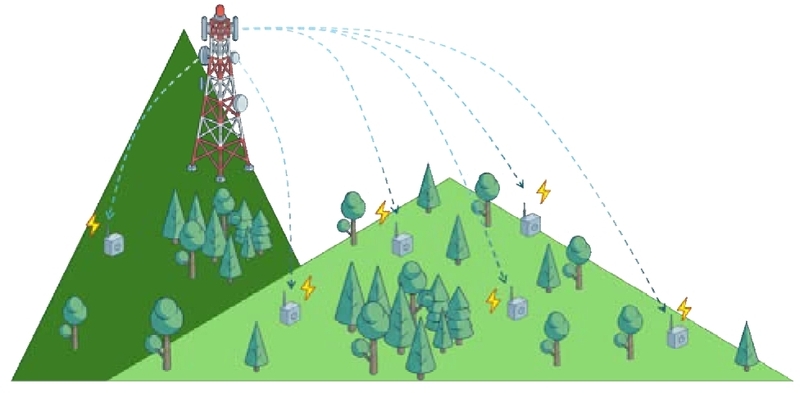
System concept of broadcast-based WPT
where Ptx is the transmission power, Gtx and Grx are the antenna gains, and htx and hrx denote the heights of the transmitter and receiver, respectively.
2. Waveform Design and Non-linear Rectification
The core challenge is the low RF-to-DC conversion efficiency η when the received power Prx drops below the rectifier's threshold. Due to the Schottky diode's non-linear I-V characteristics, a waveform with a high Peak-to-Average Power Ratio (PAPR) can significantly enhance efficiency in the low-power regime [5]. As shown in Fig. 2, compared to the CW, the ASK (Amplitude Shift Keying) signal exhibits high instantaneous voltage peaks. These peaks periodically overcome the diode's turn-on voltage Vth, enabling energy harvesting even with weak average input. Thus, using high-PAPR signals is a key strategy to extend the effective service coverage of the broadcast-based WPT system.
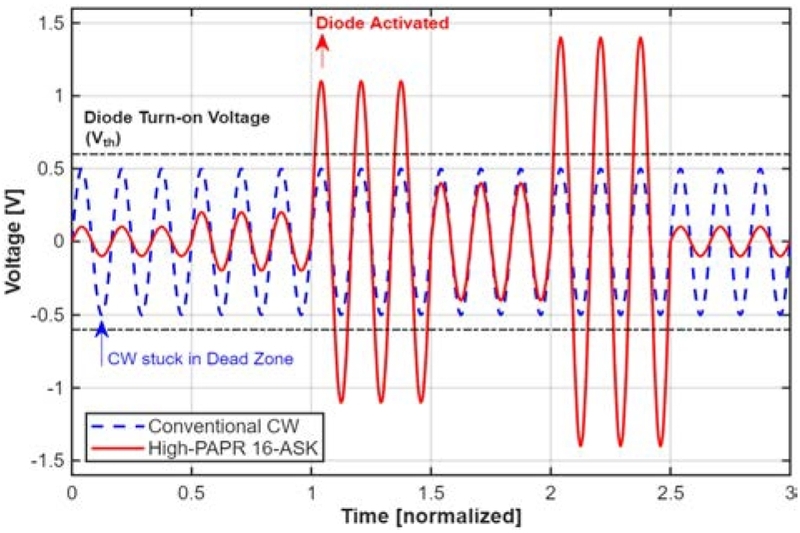
Time-domain Waveform Comparison CW vs ASK
Ⅲ. Simulation Results
1. Simulation Setup
To validate the proposed coverage extension scheme, we performed simulations assuming a broadcast tower-based WPT scenario. We selected the 5.8 GHz ISM band as the carrier frequency to facilitate preliminary verification and future experimental validation prior to deployment in actual broadcast frequency bands. The Two-Ray Ground Reflection model used to model the propagation channel characteristics in the target environment, where the antenna configurations were set to represent a typical outdoor transmission environment. The average transmission power was fixed at 1 W (30 dBm) for all test signals to isolate the impact of PAPR. We analyzed various modulation schemes, including 16-ASK (Amplitude Shift Keying), 16-QAM (Quadrature Amplitude Modulation), and 16-PSK (Phase Shift Keying), to verify the coverage extension capability. These schemes were selected because they represent distinct PAPR levels and are widely adopted in broadcast and communication systems.
2. Efficiency and Coverage Analysis
To evaluate the impact of modulation schemes on coverage performance, Fig. 3 presents the harvested DC power characteristics with respect to the transmission distance.
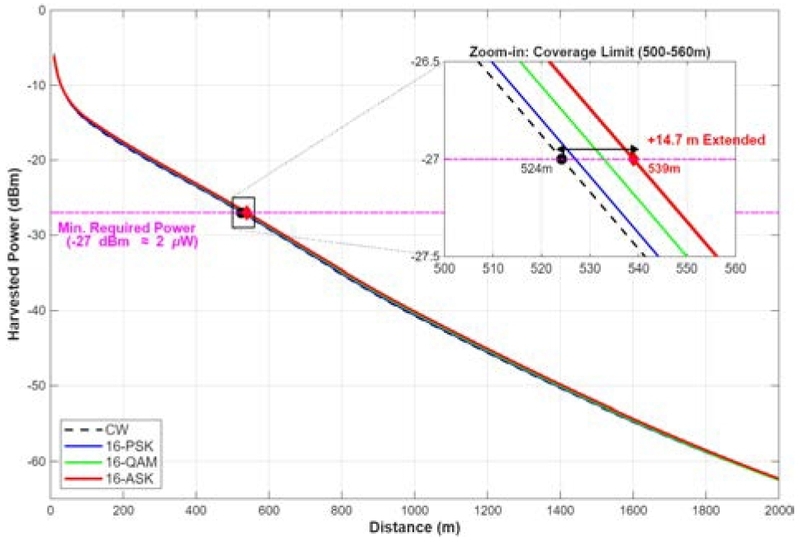
Harvested DC power characteristics versus transmission distance
In the short-range region (10–100 m), modulated signals (16-ASK, 16-QAM, 16-PSK) perform slightly worse than CW signal. This is because, in the high-power regime where the diode is fully turned on, the PAPR gain becomes negligible, and the modulation envelope introduces minor conversion losses.
However, a distinct performance gap appears as the distance increases. As highlighted in the inset of Fig. 3, we set the minimum required power threshold to -27 dBm (approx. 2 ㎼), reflecting the lowest power consumption level of commercial low-power sensors. Under this condition, the CW signal reaches its coverage limit at 524 m. In contrast, the high-PAPR 16-ASK waveform extends the operational range up to 538.7 m, achieving a 14.7 m of coverage extension. This is attributed to 16-ASK's high peaks overcoming the diode's turn-on threshold where CW fails.
Fig. 4 compares the relative power improvement of the modulated signals against the CW signal to quantify the performance advantage in realistic scenarios.
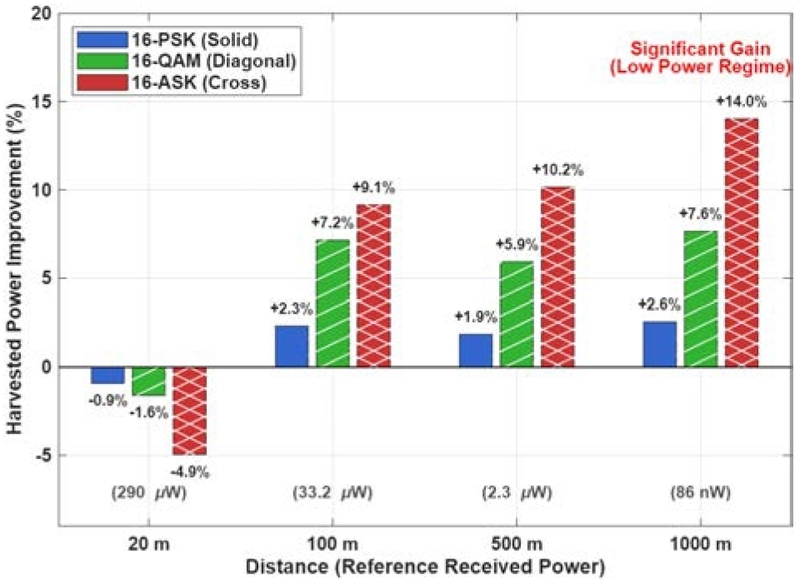
Relative harvested power improvement (%) of modulated signals compared to the CW baseline
In the near-field region (20 m), where the received power is relatively high (approx. 290 ㎼), the 16-ASK waveform shows a slight performance degradation of -4.9% due to the modulation overhead. However, as the distance increases and the received power drops to the microwatt level, the high-PAPR advantage becomes evident. At distances of 500 m (approx. 2.3 ㎼) and 1000 m (approx. 85 ㎻), 16-ASK achieves substantial power improvements of 10.2% and 14.0%, respectively. This confirms that modulation provides critical energy gains in energy-constrained far-field environments, extending coverage without increasing transmission power.
Ⅳ. Conclusion
This letter investigated the feasibility of using terrestrial broadcast infrastructure as a sustainable power source for massive IoT sensor networks. We proposed a coverage extension strategy that uses the high PAPR characteristics of standard digital modulation signals to overcome the physical limitations of diode rectifiers in long-range transmission. Simulation results using a Two-Ray Ground Reflection model confirmed that the 16-ASK waveform significantly improves RF-to-DC conversion efficiency in low-power regimes compared to conventional CW transmission. Specifically, the proposed approach extended the effective service coverage by approximately 14.7 m without any increase in transmission power. These findings suggest that repurposing existing broadcast networks is a promising solution for powering energy-constrained IoT devices in disaster-prone or inaccessible regions. We anticipate that applying this strategy to actual broadcast standards (e.g., ATSC 3.0) at lower frequencies could further enhance coverage due to superior diffraction characteristics. Future work includes practical prototype field trials and adaptive waveform optimization studies. Ultimately, this highlights the critical role of waveform design in battery-free connectivity.
Acknowledgments
This research was supported by the National Research Foundation of Korea (NRF) grant funded by the Korea government (MSIT) (No.RS-2023-00243069)
References
-
P. P. Ray, M. Mukherjee and L. Shu, “Internet of Things for Disaster Management: State-of-the-Art and Prospects,” in IEEE Access, vol. 5, pp. 18818-18835, 2017.
[https://doi.org/10.1109/ACCESS.2017.2752174]

- Korea Communications Commission (KCC), “2024 Annual Report,” Seoul, South Korea, 2025.
-
M. Piñuela, P. D. Mitcheson and S. Lucyszyn, “Ambient RF Energy Harvesting in Urban and Semi-Urban Environments,” in IEEE Transactions on Microwave Theory and Techniques, vol. 61, no. 7, pp. 2715-2726, July 2013.
[https://doi.org/10.1109/TMTT.2013.2262687]
-
A. Boaventura, A. Collado, N. B. Carvalho and A. Georgiadis, “Optimum behavior: Wireless power transmission system design through behavioral models and efficient synthesis techniques,” in IEEE Microwave Magazine, vol. 14, no. 2, pp. 26-35, March-April 2013.
[https://doi.org/10.1109/MMM.2012.2234631]
-
B. Clerckx and E. Bayguzina, “Waveform Design for Wireless Power Transfer,” in IEEE Transactions on Signal Processing, vol. 64, no. 23, pp. 6313-6328, 1 Dec.1, 2016.
[https://doi.org/10.1109/TSP.2016.2601284]